Groundbreaking New Intervention Promises to Reduce Heat Exposure Among Homeless Populations

Researchers propose revolutionary “HOME” program

In a startling departure from conventional approaches to heat vulnerability, a team of researchers has proposed what they’re calling the Housing-Oriented Mitigation of Exposure (HOME) program. The controversial intervention involves providing permanent indoor shelter to people currently experiencing homelessness.

“We know that unhoused populations face extreme heat exposure during heatwaves,” explained the research team. “But what if, instead of deploying pop-up cooling hubs for a few hours during code red days, we simply gave people actual houses?”

The proposal has raised eyebrows in the public health community, where the dominant paradigm has focused on innovative temporary solutions such as misting stations, bottled water distribution, and air-conditioned shopping centre access during business hours.

Unexpected Co-benefits

While the primary outcome of the HOME intervention is reduced heat-related morbidity and mortality, researchers noted several surprising co-benefits that emerged during the pilot phase:

  • Sleep improvement: Participants reported better sleep quality when not sleeping rough in 35°C overnight temperatures or being moved on by police at 3am
  • Reduced disease burden: Access to refrigeration for medications, running water for hygiene, and protection from weather appeared to improve multiple health outcomes beyond heat illness
  • Mental health gains: Having a permanent address, lockable doors, and the capacity to plan beyond the next 24 hours showed unexpected psychological benefits
  • Economic productivity: Participants were better able to maintain employment when they could reliably shower, store clean clothes, and list a residential address on job applications
  • Social connection: Homes apparently provided a space where people could maintain relationships, host family visits, and participate in community life

“We didn’t anticipate these additional effects,” researchers admitted. “We were focused purely on the heat exposure pathway.”

Scalability Concerns

Critics have questioned whether the HOME program can be scaled effectively. “Pop-up cooling hubs are evidence-based, cost-effective interventions that can be deployed rapidly during heat events,” noted one public health official. “They’re also time-limited, politically uncontroversial, and don’t challenge existing property markets.”

Critics questioned the program’s scope. ‘The HOME intervention only addresses heat exposure,’ noted one emergency management official. ‘What about flooding? Bushfire smoke? We can’t just give people houses every time there’s an environmental hazard. We’d need separate programs for each risk.’

Implementation Barriers

The research team acknowledged several barriers to implementation:

  • Unlike cooling hubs, houses cannot be folded up and stored when not needed
  • The intervention may reduce burden on emergency departments, but lacks the targeted efficiency of cooling hubs that keep homeless people out of hospitals, shopping centres, and other air-conditioned spaces where they might otherwise seek refuge
  • Permanent housing lacks the visibility and photo opportunities of pop-up community responses
  • The program may set a precedent for addressing root causes rather than managing symptoms

A Cost-Effectiveness Paradox

The economic case for cooling hubs has been strengthened by research from St Vincent’s Hospital demonstrating that homeless people presenting to emergency departments during heatwaves impose substantial costs on the health system. A recent study found these presentations peaked during extreme heat events, with many homeless individuals seeking the refuge of air-conditioned hospital waiting rooms.

“Cooling hubs provide a cost-effective alternative,” explained health economists. “Rather than having homeless people access emergency department air conditioning—which involves triage nurses, security, and occasional medical intervention—we can direct them to designated cooling spaces with volunteer supervision.”

When asked whether providing actual housing might be even more cost-effective by preventing the health conditions requiring emergency care in the first place, researchers noted this fell outside their study parameters.

“We’re focused on heat-specific interventions,” they clarified. “The fact that homeless people also use emergency departments for warmth in winter, shelter during storms, somewhere to sit that isn’t being actively criminalised, and occasional medical crises is really beyond the scope of heat mitigation research.”

Protecting Existing Cooling Infrastructure

Shopping centres, libraries, and cafes have traditionally served as informal cooling refuges, though managers have expressed concerns about homeless individuals occupying these spaces.

“Pop-up cooling hubs solve this problem elegantly,” noted one retail association spokesperson. “By providing alternative cooling locations, we can maintain the amenity of our air-conditioned spaces for customers while still demonstrating community concern for heat vulnerability.”

The HOME program’s proposed approach of simply giving people their own air-conditioned spaces raised concerns about who would then occupy the designated cooling hubs during future heatwaves. “We’ve invested significantly in this infrastructure,” explained council officials. “What’s the point of having cooling hubs if people don’t need them?”

Funding Challenges

While a single pop-up cooling hub costs approximately $50,000 to deploy (requiring annual renewal for each heat season), the HOME program’s estimated cost of $500,000-800,000 per housing unit has been described as “prohibitively expensive” by government officials who recently approved $2.3 billion for new stadium infrastructure.

“We need to be realistic about what’s achievable within existing budget constraints,” explained a treasury spokesperson, before announcing an $18 million grant for a new advertising campaign about heat awareness.

The Path Forward

Despite these challenges, researchers remain cautiously optimistic. “We’re not saying cooling hubs don’t have their place,” they clarified. “Obviously if someone has no home, it’s better they can access shade and fans for three hours on a 42°C day than not. We’re simply asking: what if we also considered addressing the ‘no home’ part of that equation?”

The HOME pilot program is currently seeking funding, though researchers noted that grant applications are complicated by the intervention’s failure to fit neatly into existing research frameworks. “The funding category is unclear,” they explained. “Is it heat mitigation? Social housing? Urban planning? Public health? The interdisciplinary nature has been challenging.”

“Also,” they added, “we keep getting reviewers saying our approach lacks novelty because housing already exists. We’ve tried explaining that the novelty is in providing it to people who currently lack it, but that hasn’t gained much traction.”

When reached for comment, several people currently sleeping rough in Sydney’s western suburbs expressed enthusiasm for the proposed intervention, noting it compared favourably to existing options such as “seeking shade under bridges,” “trying to access overcrowded shelters with 6pm curfews,” “being criminalised for existing in public space,” or “presenting to emergency departments with heat exhaustion while trying not to look like you’re just there for the air conditioning.”

The research team plans to present their findings at next year’s conference on Climate Change and Health, scheduled to take place in a five-star hotel with air conditioning set to 18°C.

This is satire. But cooling hub programs are real and housing-first approaches actually work.
Is it time to rethink Australia’s tobacco tax?

Australian state governments are calling for tobacco tax cuts to address the growing illicit market. The Commonwealth has ruled it out. This isn’t a policy debate – it’s a standoff between the level of government that collects the revenue and the levels that deal with the consequences. But there’s a deeper problem: many government representatives and public health advocates won’t even acknowledge that high taxes are driving the black market in the first place.

Following the incentives

The political economy here is stark. The Commonwealth collects tobacco tax revenue, which was still around $7 billion last year (down from $16 billion 5 years ago), despite declining legal sales. Even as the illicit market continues to grow and tax revenue shrinks, it’s still a net positive for the Treasury compared to the alternative of cutting the tax. States bear the enforcement costs: escalating illicit markets, failing enforcement efforts, violence, organised crime, and community outrage. With legal cigarettes at $50 per pack versus illicit cigarettes at $15 (or less), only one level of government depends on maintaining that $50 price point.

States calling for tax cuts aren’t being “soft on tobacco” – they’re being realistic about enforcement limitations. They face the daily reality that you can’t simply police away a market when a 70% price advantage creates structural incentives for illicit trade. The Commonwealth can maintain its position only by denying this basic market logic and offloading enforcement costs (and thus opportunity costs) to states.

The “enforcement success” fallacy

Record seizures and shop closures are being celebrated as evidence that enforcement is working. But this misreads what these numbers mean. Seizures indicate market scale, not suppression success. If you keep plucking more weeds in your garden each week despite constant weeding, that doesn’t mean your weeding strategy is working, it means weeds are growing faster than you can remove them.

The fact that seizures keep breaking records, that new shops keep opening, and that states keep needing more enforcement powers, suggests the market is outpacing enforcement capacity. Closing individual shops addresses symptoms, not the structural conditions that make the illicit market viable. With a $15 versus $50 price differential, what prevents the next shop from opening or pushing people to more underground channels?

Enforcement has never successfully suppressed markets with this kind of demand structure and price advantage. The war on drugs demonstrated this conclusively. You cannot enforce away the basic economics of supply and demand when price differentials are this large.

The false binary trap

A common objection to tax reduction goes: “Even reduced taxes can’t compete with $7-$15 illicit packs, therefore tax cuts won’t work, therefore don’t try them.” This commits a classic false binary fallacy. The question isn’t will or won’t tax reduction eliminate the black market. The question is: at what point does the price differential become manageable for enforcement?

Currently, enforcement is trying to suppress a 70% price advantage ($50 vs $15). This is futile. But if tax reduction brought legal packs to, say, $30, enforcement would face a 50% price advantage. That’s still significant, but potentially within the range where enforcement plus other interventions might actually work. Narrower margins make enforcement viable; current margins make it impossible.

Dismissing tax reduction because it won’t completely solve the problem ignores degrees of difficulty. No single intervention will eliminate illicit tobacco. The question is whether tax reduction, combined with other measures, could make the problem manageable. Current pricing ensures the black market persists regardless of enforcement intensity.

The denial problem

Perhaps the most striking feature of current debate is how many actors refuse to acknowledge what drives the illicit market. Some treat the black market as an independent problem requiring only enforcement, not as a predictable response to prohibition-level pricing.

This isn’t evidence-based policy. It’s motivated reasoning protecting the tax policy. Basic economics tells us that when a legal product costs 3-5 times more than an illegal alternative, markets respond predictably. Wastewater analysis confirms consistent nicotine demand despite rising prices – people aren’t just quitting, they’re switching to alternative sources of nicotine.

Why the denial? Because acknowledging causation means admitting that current policy created the problem. It threatens the “high taxes equal public health success” narrative. Most importantly, it threatens the revenue stream the Commonwealth depends on. But you can’t design effective interventions while denying the mechanism that created the problem.

The moral purity trap

There’s something revealing about the intensity of resistance to even discussing tax reduction. Part of this is straightforward: tobacco causes enormous harm, and any policy that might increase smoking is unconscionable. But there’s something else operating here – a concern about moral murkiness.

Being associated with tax reduction means being associated with tobacco industry positions. In tobacco control circles, this is deeply stigmatising. The industry has lobbied against tax increases for decades, so anyone calling for review of the tax risks being seen as industry-aligned, regardless of their actual reasoning or evidence base. We can’t look past the distaste of doing something that might be in the interests of the tobacco industry, even if evidence suggests it might work.

This creates a perverse incentive structure: maintaining moral purity on tax policy becomes more important than examining whether the policy is actually working. You can hold the “right” position (high taxes) even if outcomes are poor, and this is morally safer than holding a “compromised” position (tax reduction) even if outcomes might improve. We can’t send a signal to industry or the public that we’re going soft on tobacco and sanction cheaper cigarettes which might cause smoking rates to increase again.

The result is a striking paradox: tobacco is effectively getting cheaper through black market competition, but this is somehow more acceptable than tobacco getting cheaper through policy adjustment. Indirect consequences of our actions – unregulated products, criminal networks controlling supply, violence in communities where illicit trade operates, marginalised populations dependent on organised crime for an addictive product – are preferable to the direct consequence of intentionally reducing the tax.

At least, the reasoning seems to go, these negative outcomes weren’t what we intended. We maintained our principles. We stayed tough on tobacco. The fact that the policy created worse conditions can be blamed on criminals, enforcement failures, or inadequate government commitment – anything but the policy logic itself.

This is moral positioning substituting for consequentialist analysis. It prioritises appearing tough on tobacco over actually reducing tobacco-related harm. And it means that even catastrophic policy failures won’t trigger reconsideration, because reconsidering means moral contamination.

The missing equity analysis

Remarkably absent from enforcement-focused arguments is any serious discussion of equity. Smoking remains highly prevalent, and is increasingly concentrated, among marginalised populations despite intensified policies including the tobacco tax.

Current policy creates no pathway to reduced harm for these groups. If enforcement “succeeds” in pushing people back to the legal market, success means extracting $50 packs from people who can least afford it. If enforcement fails, people sourcing unregulated products sold through criminal networks, with all the associated risks – no quality control, exposure to organised crime, potential for violence in communities where illicit trade operates – will be the completely undesirable outcome.

This is the multiple harm framework: populations already disadvantaged by smoking are then subjected to either punitive extraction through regressive taxation, or reliance on criminal markets for an addictive product. This isn’t “tough on smoking” – it’s a policy architecture that ensures the most disadvantaged bear the greatest costs.

Putting tax reduction “on the table”

To be clear: I’m not claiming tax reduction is a silver bullet. I’m not arguing it’s the only intervention needed. I’m arguing we must be able to put tax reduction on the table for discussion as part of a comprehensive strategy to regain regulatory control.

You cannot design effective policy with options ruled out ideologically. If we’re serious about addressing the illicit market, we need the full toolkit available. This might mean tax adjustment combined with better cessation support through alternative nicotine products, reformed regulatory frameworks, and smarter enforcement. But refusing to examine the tax question prevents rational policy design.

The test is simple: if black market reduction was the actual priority, all evidence-based options would be considered. If tax reduction remains unthinkable regardless of evidence, then other priorities – like revenue protection – are operating.

Toward honest policy

Australia faces a genuine challenge with illicit tobacco. But the current debate is stuck between two inadequate positions: “enforce harder” (ignoring structural market conditions) and “maintain high taxes” (ignoring equity and Commonwealth-State misalignment).

Neither acknowledges the fundamental bind: prohibition-level pricing creates enforcement-resistant markets. States understand this because they face enforcement reality. The Commonwealth can maintain its position only by denying basic market economics.

Tax reduction might not work perfectly. But neither will the status quo. It’s true that reducing the tax would be an extraordinarily expensive policy for the Commonwealth – in terms of loss of both tax revenue and political face. But we need to have honest accounting of what the true costs are, and whether the government is truly committed to regaining control of tobacco.

Can we really measure how many people die from heat (or cold)?

Epidemiologists can model how many deaths occur during heatwaves. But what these numbers don’t tell us is how many deaths can be prevented – or by whom. Ambient temperature isn’t a modifiable exposure. Vulnerability is.

Each summer, headlines tell us that thousands of people die because of hot weather. The numbers are striking, and they’re meant to be. They often come from complex epidemiological models that estimate how many deaths are “due to high temperatures” or “excess deaths during heatwaves.”

But what does that actually mean? What’s the world in which those people wouldn’t have died? And who, exactly, could have prevented it?

Heat and cold are important environmental stressors for health. But when we ask how many deaths are caused by temperature, we risk asking a question that makes little sense for public health – because there’s no realistic counterfactual in which ambient temperature itself could have been removed or reduced.

What these studies actually do

We know, through a wealth of epidemiological and physiological evidence, that exposure to high and low temperatures increases risk of various health outcomes through a number of pathways. Epidemiological studies (including my own) consistently show a “U-shaped” curve of ambient temperature (or some other index of heat and cold) and health risk. These aren’t just specific outcomes like heat stroke or frostbite, but exacerbation of underlying conditions like cardiovascular disease leading to higher (excess) rates of common conditions – and mortality.

These studies are technically sophisticated and often yield consistent conclusions: mortality rises during extremes, especially heatwaves, and climate change will make such events more frequent and intense. None of that is in dispute.

But at this level, ambient temperature is being used as a proxy for exposure – usually measured as the average outdoor temperature at a monitoring station or grid cell. Yet what people actually experience depends on far more: housing quality, access to cooling, work conditions, clothing, urban design, shade, and even social isolation. In other words, the “exposure” in these models is rarely what individuals are physiologically exposed to. So its reliability as a proxy is dependent on these mediating factors.

The problem deepens when those associations are translated into burden estimates – statements about how many deaths were “caused by hot or cold days.” Different methods are used to estimate this figure using the underlying exposure-response relationship from epidemiological studies. Some studies estimate deaths occurring outside an “optimal” temperature range – adding up deaths attributable to hotter and colder days compared with a scenario where all days were at the ideal temperature at the bottom of the curve. Others focus on extreme events, such as heatwaves or cold snaps, comparing mortality during those periods to nearby “normal” days. The logic assumes that the ambient temperature could have been potentially modified through some sort of action or policy. But we know this isn’t true.

To say that deaths are “due to high or low temperatures” implies a counterfactual world in which the ambient temperature was different, or can be fixed at some ideal value. That is not a meaningful or actionable counterfactual for public health. In the case of non-optimal temperature, it is not even a desirable counterfactual wherein each day was the same temperature as the last.

The counterfactual confusion

Now you might say in response “what about climate change?!” And yes, of course, ambient temperatures can and do change. Climate science gives us a range of plausible worlds, each defined by different emissions pathways. Those are genuine physical counterfactuals: if we emit less carbon, the planet warms less.

Comparing future climate scenarios is of course important for climate science and population health, and can be used to advocate for climate action which will in turn have health benefits in the future. However, estimating the current burden answers a different study question and has little meaning or utility for public health in the present day.

Public health counterfactuals must describe conditions that people, institutions, or governments could realistically change – better housing, safer workplaces, affordable energy, urban greening, economic redistribution. These are the levers of prevention or health protection. We can reduce the impact of ambient temperature by reducing personal exposure, but we cannot readily modify ambient temperature itself.

When burden estimates treat temperature as though it were modifiable, they cross that boundary. They import a climate-science counterfactual – a world with different mean or extreme temperatures – into a frame that is supposed to guide action for reducing the population health risk. The result is an elegant model that answers the wrong question.

Why this matters

This slippage between domains has real consequences for how we understand and govern risk.

First, it creates the illusion of control. By producing a single number – say, 1.2 million cardiovascular disease deaths due to non-optimal temperature globally – it implies we can measure and manage deaths “caused” by climate itself. But no policy can reduce (or increase) ambient temperature in the present day. What they can change are the conditions that make people vulnerable to it. These figures explicitly do not estimate the what is avoidable through specific actions. Likewise, they aren’t comparable to burden estimates for issues we can and should change like access to safe drinking water or sanitation.

Second, it obscures responsibility. If “temperature” kills, then who is responsible? The weather? Carbon emitters? Or the policy systems that fail to protect people from heat and cold exposure? Framing temperature as the cause subtly erases the socioeconomic causes of vulnerability. The risk doesn’t come from heat and cold alone, but from how societies are organised – who can afford cooling and heating, who works outdoors, who lives in poorly insulated housing, who has access to care.

Third, it leads to misplaced intervention. When confronted with big numbers about “deaths due to heat,” the most common public health response is to inform and warn – to issue alerts, publish advice, and promote “heat-health” campaigns. These efforts can be useful, but the burden estimates themselves don’t tell us how much harm can actually be prevented this way. The people most at risk – the elderly, socially isolated, those without secure housing or income – are often least able to act on warnings. So while the numbers create urgency, they don’t identify solutions.

The confusion isn’t only theoretical. In Central America and South Asia, tens of thousands of sugar-cane cutters and other outdoor workers have developed chronic kidney disease, often attributed to repeated heat stress and dehydration. But again, the problem isn’t temperature alone – it’s the working conditions that make cooling or rest impossible. Calling it a “climate-related” disease risks shifting attention away from exploitation, labour rights, water access, and the political economy of agriculture. The same logic applies to “heat deaths”: if we blame the weather, we absolve the systems that force people to endure it.

Finally, there’s a moral cost. Talking about “heat deaths” as though temperature itself were the culprit risks fatalism. It makes the impacts of climate change sound like a force of nature rather than a social and political project. The problem to be fixed isn’t the heat – it’s who has to live and work in it without protection.

What a better counterfactual looks like

A meaningful counterfactual for public health must specify who acts, on what, and how. It has to imagine a world in which the mechanisms of vulnerability – not the climate itself – are different.

Instead of estimating “how many deaths were caused by hot or cold days,” we might ask: how many of these deaths occurred because people lived in poor housing, or lacked access to cooling, or had to work outdoors without breaks? These are counterfactuals that point toward real interventions.

Or maybe we don’t even need such numbers to take action to improve housing conditions and working conditions, and reduce inequality.

This doesn’t make temperature–mortality studies useless. They help us understand patterns of risk and the consequences of a warming world. But when we translate those findings into burden estimates – numbers that claim to represent preventable deaths – we need to be clear about what, and whose, action is implied.

Counting what can be changed

Public health exists to prevent harm. To do that, we need counterfactuals that are not just imaginable, but actionable. The world without heatwaves is not one we can build. The world with adequate protection from them is.

Ultimately, burden of disease estimates for heatwaves and non-optimal temperatures are not telling us what we want to know and might lead us away from what we need to do to protect health.

Perhaps the better question, then, is not how many deaths are due to hot or cold temperatures, but how many deaths occur because we failed to protect people from them.

The difference is subtle but profound. It shifts the focus from climate as an abstract force to vulnerability as a social fact. It replaces the fiction of an “optimal temperature” with the practical question of a more equitable society.

The dangerous allure of false equity arguments

Over the past few years, something to which I have kept returning is how often equity is invoked in debates about public health and the environment – and how often those claims don’t really hold up.

I started to think of these as false equity arguments. A false equity argument is when the language of justice is used to defend or promote a policy that doesn’t actually make things more equal – and may even perpetuate or exacerbate inequalities. On the surface, it sounds progressive, even caring. But underneath, it distracts us from the real sources of inequity: socioeconomic inequality, racialised disadvantage, and power imbalances.

And this is the basis for the argument I want to share: doing one and not the other is the injustice. If we only focus on reducing exposures to environmental hazards, but fail to address the unequal distribution of their impacts, we are left with injustice. And worse, when equity is invoked falsely, we risk cementing those inequalities rather than dismantling them.

Exposure, Vulnerability, and Shared Causes
When we talk about exposure and vulnerability, we often describe them as if they are separate: who is more exposed to hazards, and who is more vulnerable to their effects – we also treat one as modifiable and the other as intractable. But in reality, they are two sides of the same coin.

The reason disadvantaged groups are more exposed is the same reason they are more vulnerable: underlying socioeconomic inequality often racialised, and unequal access to power.

Think of a low-income family living in cheaper housing close to a major road. They’re more exposed to transport pollution because of where they live. But that same family is also more vulnerable to the health effects of pollution because of their socioeconomic disadvantage.

This is not a coincidence – it’s the same inequality showing up in different forms. Exposure and vulnerability share a mutual cause: the structural inequalities that leave some groups with fewer choices, fewer protections, and less voice.

So if we focus only on reducing average exposures, we miss the bigger picture. Without addressing the underlying inequality, the same groups will remain both more exposed and more vulnerable. And that’s why doing one without the other is the injustice.

Case Study: The EV Road User Tax
Let me illustrate this with a current example in Australia. The government has proposed a road user tax for electric vehicles. The justification is straightforward: as fuel excise revenue falls, governments need a new way to offset these losses.

Climate and health advocates responded by saying: “At a time when we need to be accelerating electric vehicle adoption to meet climate and health goals, a road user tax risks punishing people for making cleaner, healthier transport choices. Australia’s most vulnerable communities already bear the brunt of transport pollution. Disincentivising electric vehicles now will only deepen existing health and environmental inequalities.”

It’s a powerful statement – but here’s the problem. This is a false equity argument. While I agree that the government should intervene in the market to incentivise electric vehicle uptake over fossil fuel-powered ones, it’s not inherently equitable. Right now, EVs are purchased by wealthier households (who live in wealthier areas). Saying that taxing them is unjust for disadvantaged groups is misleading, because those groups are not the ones buying EVs in the first place, and the air pollution reductions from EV uptake will not be distributed equitably.

What this does is distract from the real injustice: socioeconomic inequality itself. The people who are most exposed to transport pollution are those living near major roads, in lower-income housing, without access to cleaner transport. Not taxing EVs doesn’t change that. It doesn’t change who can afford to drive one, or who still breathes the pollution.

And here’s the deeper injustice: when equity language is invoked in this way, it makes it seem as though we are addressing inequality – but in fact, we are doing the opposite. We are using inequality rhetorically to defend a policy that benefits the already privileged, while leaving the root causes of inequity untouched.

So the lesson here is: calling something equitable does not make it so. Environmental justice requires both reducing hazards and addressing the socioeconomic inequalities that determine who suffers the harms and who enjoys the benefits. Doing one without the other is the real injustice.

So what does all of this mean for understanding the distribution of environmental health risks and benefits?

First, it means that averages are not enough. We cannot measure success in environmental health or climate policy purely by reductions in aggregate exposures. Cleaner air, lower emissions, fewer toxins –these are necessary, but they are not sufficient. The real tests are whether the gaps in exposure and vulnerability are narrowing, and whether the same groups remain trapped in cycles of disadvantage.

Second, it means our research and teaching need to grapple explicitly with those structural drivers. As academics, we often analyse exposures and outcomes, but pay less attention to the political economy that creates them. If exposure and vulnerability share the same root cause, then environmental justice requires us to look upstream – to land use, to labour markets, to welfare and housing policy, to the distribution of political voice.

Third, it has implications for policy design. Environmental justice is not simply about removing hazards; it is about redistributing both risks and benefits. That means asking: who is positioned to gain from this policy, and who is left behind? For electric vehicles, it means pairing uptake incentives with measures that directly benefit low-income communities – like subsidising public transport, investing in cleaner fleets in high-pollution areas, or improving active transport options.

Fourth, it means we must be careful about the language of equity. As I’ve tried to show, invoking equity to defend policies that do not actually redistribute benefits is misleading. These false equity arguments can be seductive, because they make us feel like we are addressing injustice when, in fact, we may be entrenching it. They distract attention away from the structural drivers – socioeconomic inequality and power imbalance – that produce both greater exposure and greater vulnerability.

And finally, there is a normative point. Justice requires us to name injustice honestly. We cannot let the language of equity be used as cover for inequitable policies. And we cannot be satisfied with policies that reduce exposures while leaving inequalities untouched. Doing one and not the other is the injustice.

Counterfactual complacency

In epidemiology, excess deaths can be a useful metric to quantify and compare the health burden of a risk factor or disease. The figure can help in prioritising and assessing problems and solutions. However, decisions we make regarding how we calculate excess deaths have a large bearing on how we ought to interpret the number. These decisions are also implicitly value-laden, exposing our attitudes about whose deaths are more or less acceptable.

Excess deaths are a common metric used in epidemiology to represent the health burden of a particular risk factor or disease. They are the number of deaths that would have otherwise not occurred had an exposure not occurred. A broader term which we use across other outcomes is the “attributable number”, which, as you can guess, implies the number of cases attributable to a hazard.

The excess deaths metric became prominent in the public eye during the Covid-19 pandemic when it was clear that clinical diagnoses could not tell us the full picture of the burden of disease of the virus. You may have seen various estimations of this number for Australia and the world.

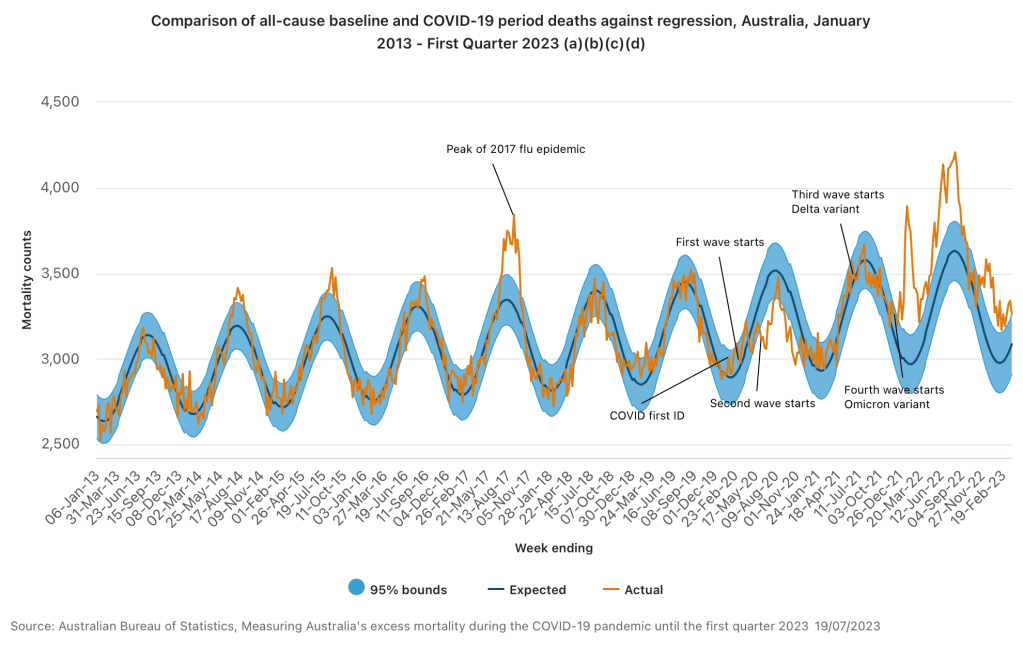
Source: https://www.abs.gov.au/articles/measuring-australias-excess-mortality-during-covid-19-pandemic-until-first-quarter-2023

While there are many caveats surrounding the use and interpretation of excess deaths to characterise the burden of disease, here, I want to focus on one specific issue which stems from the selection of the counterfactual (the scenario for comparison).

The counterfactual is an alternate reality. The difference between that world and our reality is the “excess”. In the context of Covid, we might think about this scenario for comparison as how the world would have been had the virus never existed. This is the approach taken by the Australian Bureau of Statistics (see figure above), the World Health Organisation, a team of actuaries, and various other groups with slight variations in methods. This approach takes trends in mortality within each geographical area and assumes that things would have continued in the same trajectory had Covid not existed. Subtract this from what actually happened and you’ve got the excess.

But what does this excess figure tell us?

This approach I’ve described compares reality to a completely imaginary scenario which can never happen and cannot be tested. The excess deaths figure also comprises all differences in mortality rates – those caused by Covid, as well as those caused by public health interventions: lockdowns, border closures, etc.

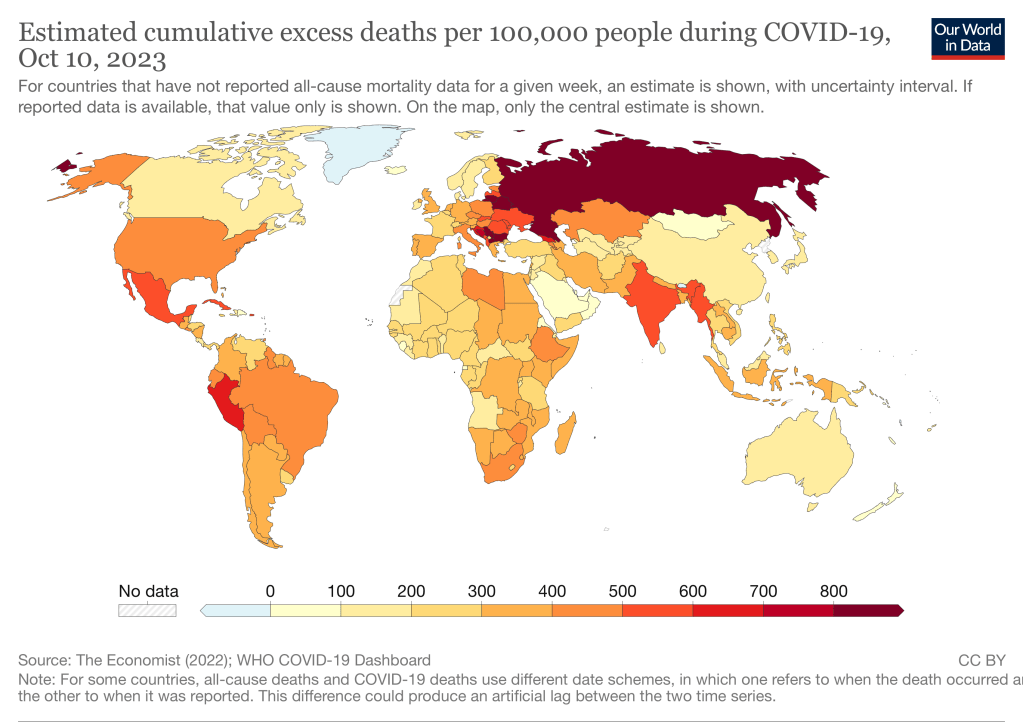
So it can be useful in comparing the overall mortality impact of the pandemic between places. Looking at the map below, you can see that Australia has a remarkably lower excess mortality compared with the rest of the world.

This choice of counterfactual also has a number of problems and limitations. One is that it inherently devalues the impact of the measures taken to prevent the spread and severity of Covid infections. A world without Covid is impossible, but a reality without interventions and vaccinations is imaginable. An NZ study estimates that 20,000 deaths were avoided through their interventions. This kind of counterfactual seems much more useful for evaluating the impact of past policies.

The excess deaths figure is also limited in what it can tell us. One thing it doesn’t tell us is the potential benefit of even more interventions–to do this we would need to consider the efficacy of interventions and the potential trade offs.

Another problem with this alternate scenario is that it over-emphasises the previous trajectory as what ought to have been. In the context of public health in Australia, there are many extreme disparities in life expectancy across different social gradients — between socioeconomic strata and between Indigenous and non-Indigenous populations.

The Actuaries’ report estimates 7% excess deaths in Australia in 2023, so far, compared to what may have been in the Covid-free universe. That figure might seem significant but pales in comparison to continuing differences between populations within Australia. For example, the annual figures for 2017-2021 of 80% excess deaths in Indigenous populations compared with all other Australians, and 50% excess deaths for those Australians living in the most socioeconomically disadvantaged areas compared to those living in the least disadvantaged areas.

Perhaps consistent with this background reality, when it comes to the impacts of Covid-19 itself on the population in Australia, the mortality rate in the most disadvantaged group was nearly three times that of the least disadvantaged group.

It is not clear to me why we would continue to compare mortality rates with a scenario in which the pandemic never happened. It doesn’t help us to measure the benefit of interventions, the harm of Covid-19, nor whether there is currently a problem that needs to be addressed.

One thing that is clear is that, as a result of action taken to mitigate the impacts of Covid-19, the net effects of the pandemic are dwarfed by that of our unequal society.

What about another alternative Covid scenario instead? How many deaths due to Covid-19 could have been avoided if the rates of mortality for all of Australia were the same as that of the least disadvantaged group? Based on ABS data, I estimate that figure (crudely) to be 45% of all deaths in Australia caused by Covid-19 (~6700 deaths could potentially have been avoided). That’s because only ~11% of Covid deaths were in the wealthiest 20% of the population.

Now, this scenario is equally as fanciful as the one in which Covid never existed. But at least it tells you something about the inequity in the distribution of the impacts—and if equity is something that you value, then perhaps it can help define and quantify the problem.

The choice to focus on the existing trajectory prior to the pandemic implicitly values the status quo—and that’s not even comparing Australia to other countries overseas.

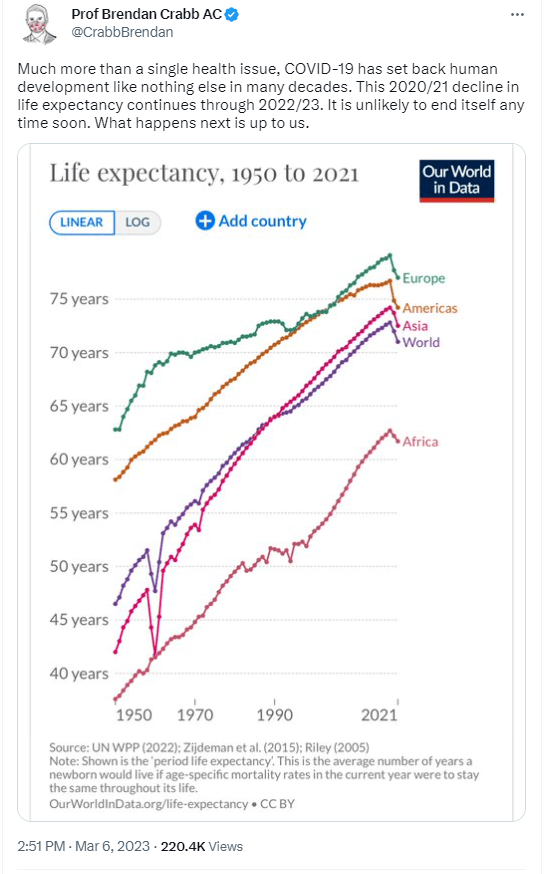
The chart in the tweet below shows the drop in life expectancy caused by the pandemic across each continent (apart from Oceania, which appears to have been removed, oddly). Besides the misleading claim in the tweet that life expectancy is continuing to fall, for me, the change in trend is nowhere near the most striking part of the graph. Life expectancy in Africa last year did not exceed life expectancy in Europe in 1950—post WWII. We know what the causes of this disparity are: poor nutrition, lack of safe water, limited access to sanitation—ie. poverty and inequality.

We’re prone to focusing on sharp shocks and crises to identify when something is not right.

However, the ongoing injustices we ignore, or choose to accept as normal, show us what we’re comfortable with—what we don’t see as problems that need to be solved. They show us which lives we value more than others.

The tobacco tax hike is not a public health measure, it’s a regressive cash grab

The increase in the tobacco excise proposed in the 2023 Budget is very unlikely to be effective in reducing rates of smoking based on previous evidence. Instead, it appears to be a revenue grab by the Federal Government dressed up as a public health intervention. The harms caused by smoking come from both the health effects of tobacco as well as the financial burden of this addictive habit. With smoking rates in disadvantaged groups remaining stubbornly high, these populations carry an inequitable burden. The reasons for which people smoke in such groups will not be addressed by this policy. Despite an increase in tobacco tax being regressive in nature, it is widely palatable due to its link to a harmful product. However, with no public health benefit, it has no ethical justification. The public health community should not allow regressive policies to pass through unchallenged and should instead strongly advocate for policies which address inequality further upstream.

Australia has been incredibly successful in changing its culture around smoking over the past few decades. This has come about following a suite of policies including smoke-free environments, restrictions on tobacco advertising and increasing the price of tobacco through taxation. Nevertheless, smoking still contributes considerably to the country’s health burden, particularly in disadvantaged populations.

In the 2023 Federal Budget the Commonwealth Government announced another increase in the tobacco excise. The health minister Mark Butler claimed the annual 5% increase in excise over 3 years is intended to make smoking more “unattractive” while raising $3.3 billion in revenue over 5 years.

Taxes like this have two aims, to reduce demand (and consumption), and to raise revenue. But due to the high rates of smoking in disadvantaged communities, taxation of tobacco products is inherently regressive (ie the poor pay more than the rich). As a public health measure, this is particularly problematic due to the fact that the harms caused by smoking come from both the health effects of tobacco as well as the financial burden of this addictive habit. The ethical justification of the policy rests on the premise that the regressive nature of the tax is offset by the potential health benefits in groups with higher smoking rates.

However, this assumes that the policy is effective in driving down rates of smoking (ie demand elasticity), particularly in these groups. If large proportions of disadvantaged people are still smoking daily and are also paying much more to do this, is it likely for there to be a net benefit for overall health? If not, the ethical justification for the policy wouldn’t hold up.

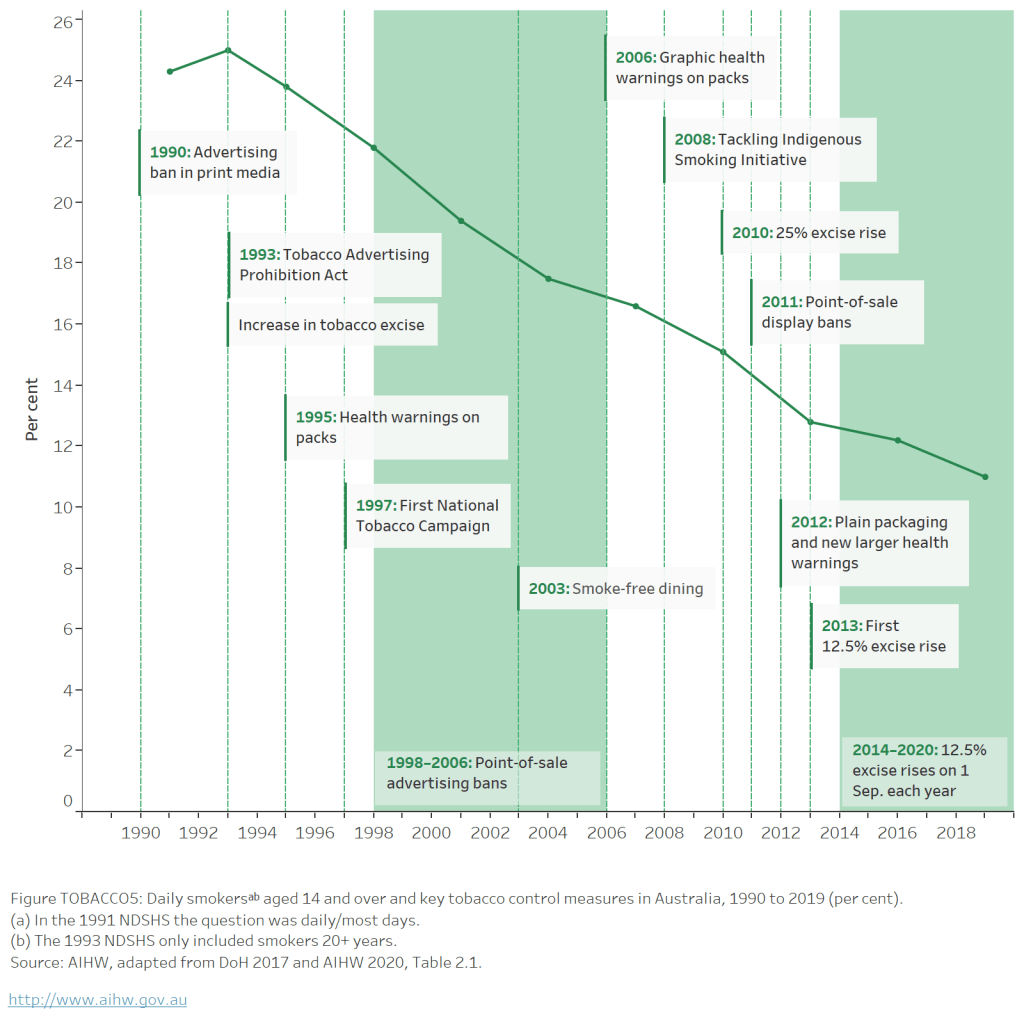
Between 2010 and 2020, there were successive increases in the tobacco excise. In 2010, a 25% increase, then annual increases of 12.5% from 2014 to 2020. This resulted in a 200% increase in the cost of cigarettes. A pack of 25 cigarettes increased from ~$13 in 2010 to ~$40 in 2020. With such an increase in price you would expect a substantial drop in the rate of smoking, right?

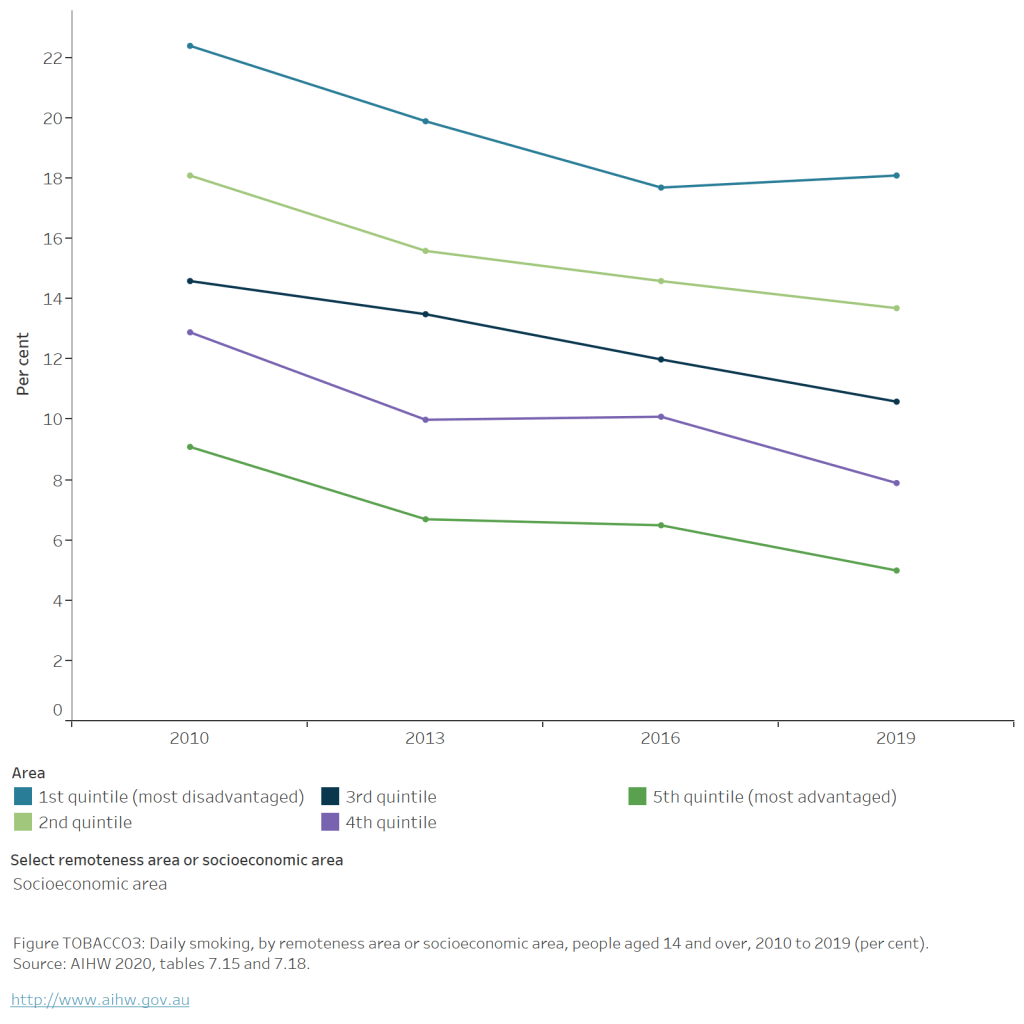
Overall, there has been a reduction in the proportion of people who smoke daily over this period. But the benefits are not substantial and are not distributed evenly. In the least disadvantaged areas in Australia, the rate of daily smokers reduced from 9% in 2010 to 5% in 2019. In the most disadvantaged areas, rates decreased from 22% to 18% in that time. So, proportionally, smoking prevalence only decreased by 18% in the most disadvantaged quintile compared with 44% in the least disadvantaged group. Between 2016 and 2019, the prevalence of daily smoking was actually unchanged in the most disadvantaged group despite a 40% increase in price in that time. So, overall, the well-off group have benefited much more from the policy than those in the poorest group.

It is possible that the amount of tobacco people consume each day has decreased in response to the increasing cost. However, this still leaves many people addicted to tobacco – including 18% of people in the most disadvantaged areas, 43% of Indigenous Australians, and 20% of people with mental health conditions who continue to smoke daily – and paying the financial and health costs.

The policy has not been successful in meeting the bar of being effective, equitable, or ethical.

Now, I’m not necessarily advocating to reduce the existing excise. But with the apparent lack of efficacy on reducing smoking prevalence of a 200% increase in total price, it’s hard to see how an annual 5% increase in the excise is going to reduce demand of tobacco – especially during a time of high inflation and cost of living. With increasing financial stress and increased prices of most everyday expenses, will a few dollars increase in the price of a pack drive someone to quit when they didn’t quit as prices rose by $30?

Given these figures, it seems extremely cynical for the government to frame this as a public health measure.

It’s clear, from the disparity in rates of smoking, that there are upstream causes of smoking which can’t be substantially modified by these kinds of proximal policies. It’s a heavily addictive substance enmeshed with our social structures. The high rates of smoking in people with mental illnesses, and in Aboriginal people and Torres Strait Islanders further confirms this.

Poverty, disempowerment and financial stress are major determinants of health across most risk factors and diseases, including increasing the risk of smoking. If raising the tobacco excise does not substantially reduce the rate of smoking, then the financial burden it creates likely contributes to a vicious cycle, further entrenching these upstream causes. It would largely be just a punitive measure.

We need to address the upstream determinants by relieving financial and social stresses, like income and housing, as well as improving access to mental health services.

As a fiscal policy, the new tax will simply raise revenue from the most disadvantaged populations in the country at the expense of our progressive tax system – coming at the same time as tax cuts for high income earners and only meagre increases to welfare payments.

As Greg Jericho points out, the tobacco excise aims to raise more revenue than changes to the Petroleum Resource Rent Tax. Now, which of these is the more important social change?

For those calling for the funds to be earmarked for health spending, I would question using money collected from people made vulnerable by our society on measures to protect health – it seems akin to using poker machine revenue for community services.

Fiscal policy still has an important role to play in improving public health and promoting equity. Let’s focus on strengthening our progressive tax system and income support payments to meet these challenges further upstream. Let’s raise welfare payments above the poverty line and remove barriers to receiving it.

I know some will say that what I’ve argued is simply a Big Tobacco talking point. While Big Tobacco does use these arguments cynically for their own interests, this does not allow us to ignore these very important policy considerations.

In public health we sometimes see well-meaning policies being promoted which unfairly affect disadvantaged people through stigma, enforcement, disempowerment, and financial burden. It is essential that we reflect on these unintended consequences and remember that our ultimate goal is to empower people and improve their ability to enjoy their lives and participate in society.

The tobacco excise is a rare tax which is palatable to people across the political spectrum. As attitudes have changed over time, it has become easy to judge smokers and justify imposing inequitable policies on them, saying it’s for their own good. The fallacy of deterrence is intuitively attractive to the public and is convenient for legislators. However, with no ethical basis, little evidence of effectiveness, and recognising the social determinants of smoking, the excise increase shouldn’t be palatable to the public health community. It’s incumbent upon public health experts to be critical, debunk misconceptions and oppose policy which undermines the principles of equity and social justice. It’s also our responsibility to explain these nuanced issues to the public and address the stigma caused by the approach thus far.

Australian Federal and state governments, and tobacco advocates have been incredibly successful in taking on the powerful interests of Big Tobacco and changing our society for the better. Despite this, these policies have not been as effective in vulnerable groups and smoking continues to be a major issue, contributing substantially to the burden of disease. This suggests that we shouldn’t be doing more of the same.

We need to put more resources into addressing the upstream causes of disadvantage. These need to be paid for not by those who are the victims of the burden but by people who benefit from the unequal society in which we exist.